Every weighing project starts with the same quiet assumption: there will be a pit. Excavation, formwork, drainage, reinforcement and cure time are treated as the price of putting a defensible number on a truck. At a permanent high-cycle weighbridge that assumption holds. At a quarry face that moves every few months, a seasonal intake point, or a temporary road checkpoint, the pit is not a price — it is the whole problem. This guide is about the equipment built for those sites, and about being honest when a fixed deck is still the better buy.
The foundation is usually the real cost
A conventional weighbridge asks for excavation, formwork, drainage and cure time before a single truck can be weighed. On a haul road or a temporary checkpoint, that sequence is the slow, expensive part of the job — not the steel. Our approach removes it from the critical path. The 58 mm sensor plate is thin enough to be set into a shallow prepared surface, so the foundation pit disappears from the schedule. For a distributor, that turns a civil-engineering project into an equipment delivery. For an operator, it means the running surface is back in service far sooner than a poured foundation would allow.
Direct burial is not the only option. Where the surface is already sound, the plate can be surface mounted and levelled, then tied into the indicator or acquisition subsystem. Either way the work is placement, connection and calibration. There is no formwork to build, no concrete to cure and no long closure of the lane. The low profile also keeps vehicles close to normal driving rather than asking them to climb a ramp, which matters when the checkpoint sits on a working road.
What a portable axle scale actually measures
Buyers often assume a low-profile plate is simply a smaller weighbridge. It is not. It is a dynamic measurement device, and that changes how you should read its specification. Vehicles do not approach in a straight line: they drift, straddle the edge of the plate, brake late or accelerate over the sensor. A single-point measurement punishes that behaviour. Full-wheel load integration sums the load across the complete wheel path, which suppresses much of the error that off-centre loading and irregular driving would otherwise put into the axle figure.
That method is what allows a checkpoint to weigh at working speed instead of forcing a stop-and-go queue. The system is quoted at ±0.5% dynamic accuracy across 1–100 km/h — Class 1 for total vehicle weight and Class E for single-axle loads, following the classification in the product manual. We state the class exactly as the manual states it rather than dressing it up, because a buyer who later has to defend a weight record needs to know the real basis of the number.
Two further figures matter on a working site. The plate is sealed to IP68, and it is rated for 150% overload. Wash-downs, abrasive dust, standing water and axles that arrive heavier than expected are normal operating conditions, not exceptions. A sensor should be chosen for those conditions before anyone looks at the indicator screen. The full hardware description sits on our portable truck weighing scale page, and the accuracy FAQ covers the classification in more detail.
Where mobile weighing earns its keep
Start with the site, not the catalogue. Portable axle weighing tends to win in four situations. First, temporary or moving weigh points: quarries and mines where the face advances, construction haul roads that are rerouted, and seasonal intake points that exist for only part of the year. Second, sites that cannot be excavated — a rented yard, a surface that must be left intact, or a lane that cannot be closed long enough to pour concrete. Third, temporary road checks and overload screening, where the requirement is a defensible axle figure at working speed. Fourth, any project where the civil-works budget is the binding constraint.
Our applications pages describe how the same product family is used across mining, ports, logistics and enforcement scenarios. The common thread is that the weigh point is either temporary, remote, or simply not worth a permanent foundation. In those cases a plate that can be placed, calibrated, moved and placed again is worth more than a deck that will outlast the need for it.
Be careful about the reverse case. If a lane is permanent and cycles thousands of times a week, a plate designed for mobility will be asked to do a job it was not optimised for. That is not a criticism of the plate; it is a specification decision, and it is cheaper to make it before the order than after commissioning.
When a fixed welded deck is still the right answer
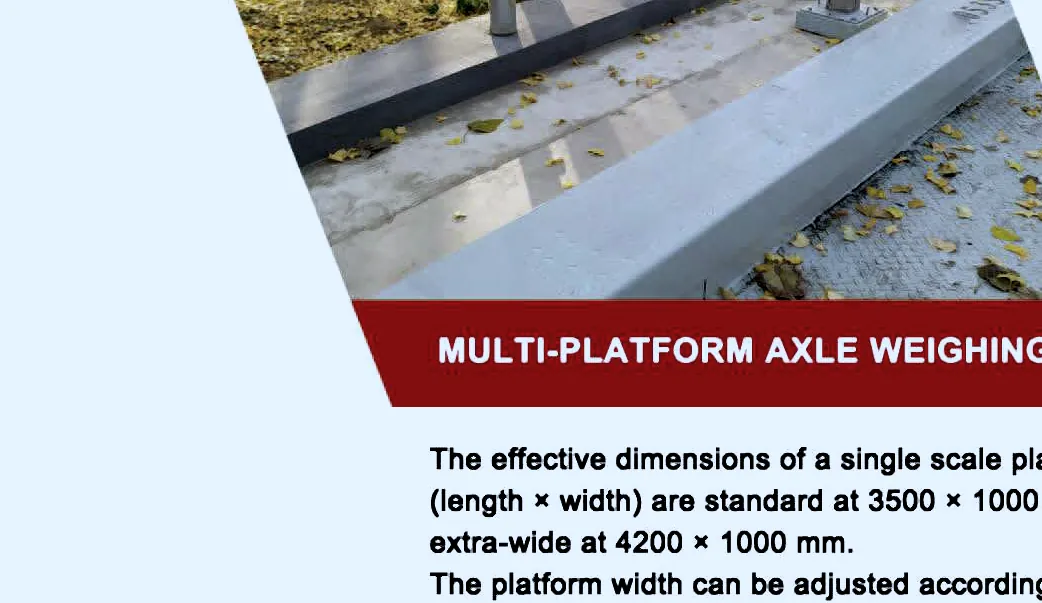
For a permanent, high-cycle weighbridge, we build U-shaped steel fully-welded closed-cavity decks. The preparation is deliberately unglamorous: Sa2.5 shot blasting, then a double-bottom, double-side paint system that leaves a dry film of at least 120 µm. The structure is validated in a third-party 2-million-cycle fatigue test. Standard deck dimensions are 3500×1000 mm with a widened 4200×1000 mm option, and ZDG multi-deck combinations let a single lane accommodate different wheelbases. Nominal capacities cover 20, 50 and 100 ton.
That is a different product with a different cost structure. It needs a foundation, and it repays that foundation with years of high-cycle service. The steel weighbridge deck page sets out the construction in full. Many distributors specify both lines for different customers, and we would rather tell a buyer that the fixed deck is wrong for a temporary site than sell the wrong thing. The same portable-versus-fixed comparison also lives in our FAQ, alongside lead time and custom deck sizes.
Specifying one: the questions we will ask
When an enquiry arrives, the first questions are never about price. They are about the load and the site:
- Axle loads and vehicle mix. What is the heaviest single axle, and what does gross vehicle weight look like across the fleet?
- Permanent or temporary. Will the weigh point still be here in two years, or does it move with the work?
- The running surface. Can it be cut, or does the plate need to sit on top of it?
- Drainage, power and data. Where does the cable run, and does the indicator need to keep records through a network outage?
- Destination and trade terms. We work to EXW, FCA, FOB, CNF, CIF, DAP and DDP, with payment by T/T.
From there the commercial frame is straightforward. Typical lead time is around 60 days, the minimum order is one unit, and the equipment is built by our own R&D, manufacturing, installation and maintenance teams in Yantai, Shandong, China. Jiajia Forge equipment is trusted in 70+ countries, and more than 10,000 units leave the workshop each year. Those are the figures we quote from; if a number is not in the specification, we have not claimed it.
Send that information and we will map it to a plate, an indicator configuration and a delivery window. If the answers point to a fixed deck instead, we will say so before anyone orders concrete. It is a short conversation that saves a long one later.
Ready to put a number on your site? Tell us the axle loads, the surface and the vehicle mix, and request a factory quote — we will come back with the configuration, the trade terms and a delivery window you can plan around.